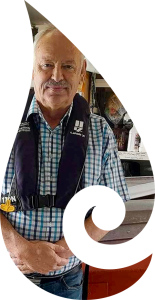
Joseph and Dad JonJoseph’s reply made Jon’s heart drop. "I'm trying Daddy, I can't. I can't." A rip lifted Joseph up and started quickly taking him away from the beach. “With little warning it goes from being…everything seems to be under control to everything's...
We All Play a Part this Water Safety Month
We All Play a Part This Water Safety Month
November is New Zealand’s Water Safety Month, and this year’s theme is “We All Play a Part”.
Water Safety New Zealand will shine a spotlight on the contributions of individuals, whānau, and communities in drowning prevention efforts across the motu. They’ll feature local champions, including surf clubs, fishing clubs, iwi, schools, and community groups.
Drowning Prevention Auckland (DPA) will also join in. In fact, this blog is all about the education, research and advocacy work we can achieve when we work together.
So, let’s take this time to acknowledge and celebrate our collaborations with sector partners, iwi, community groups, marae, and retailers. The support of others means we can offer low-cost and free resources and programmes to reach the most at-risk communities.
Together, we can all make a difference and create a stronger water safety culture in Tāmaki Makaurau Auckland and beyond – so that everyone can enjoy the water and return home safely.
Float first: sharing a lifesaving message that’s simple to remember and backed by research
Thanks to the support of our sector partners, Coastguard Tautiaki Moana, Surf Life Saving NZ, Maritime NZ, and New Zealand Search and Rescue, DPA developed the Float first survival steps (building on the RNLI’s Float to Live campaign and research by the University of Portsmouth).
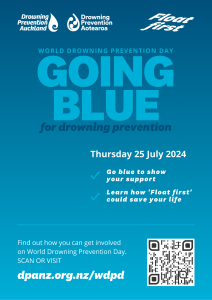
Working together, we’ve been sharing this lifesaving message across Aotearoa New Zealand as part of World Drowning Prevention Day over the last four years.
Float first has become central to our messaging, and for good reason. In moments of difficulty in the water, many panic or attempt to swim, immediately increasing their risk of cold-water shock, exhaustion and drowning.
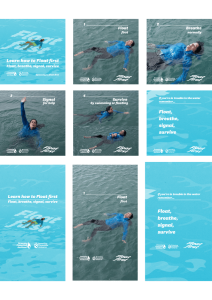
Instead, if you float, your body has the chance to calm down, save energy, and signal for help.
If you find yourself in trouble in the water, follow the four steps of Float first – float, breathe, signal, survive.
You can read more about Float first and watch a video demonstrating the four steps here.
Fishing safely from the rocks: Celebrating a 20-year partnership with Surf Life Saving Northern Region and Auckland Council
Thanks to an incredible partnership with Surf Life Saving Northern Region and Auckland council, we celebrated an amazing milestone this year: 20 years of our West Coast Rock-Based Fishers project.
As part of this project, we’ve been researching and tracking activity, behaviours and attitudes among rock-based fishers. This research allows us to deliver targeted and culturally appropriate education to keep people fishing from the rocks and land safe.
We continue to connect with the fishing community. We’re now working with New Zealand Sport Fishing Council and have a full-time advisor at Auckland’s West Coast beaches.
In recent years, with thanks to Auckland Council, we’ve been able to expand our impact by creating and sharing digital and printed materials based on the five tips of the Water Safety Code. We’ve also delivered educational sessions to reach at-risk communities.
DPA Lifejacket Hubs: Partnering with the community to improve access
Like following the four steps of Float first, wearing a correctly fitted lifejacket – that’s in good condition – can mean the difference between life and death.
That’s why we partner with community-based organisations to make it easier for people to borrow free, well-fitted lifejackets, whether that’s for rock-based fishing, boating, kayaking or something else. These hubs are especially important for families and groups who may not be able to afford or store their own safety gear.
We have nine locations across Tāmaki Makaurau Auckland, as well as three hubs across the country – Glenorchy, Whangamatā and Waikato.
View all the DPA Lifejacket Hub locations here and please take the time to fill out our Lifejacket Use Survey after you borrow a lifejacket. The information you supply helps us provide evidence for funding accountability reports and new funding applications to enable us to maintain our Lifejacket Hubs.
The Water Safety Code: A five-step framework to make better decisions
As part of our advocacy work, we’ve developed the Water Safety Code alongside our sector partners, Surf Life Saving NZ, Maritime NZ, Water Safety New Zealand, and New Zealand Search and Rescue.
The Water Safety Code was a collaborative effort to develop five simple tips to help everyone stay safe and make good decisions in, on and around water – regardless of location or activity.
The five tips – designed to be easy to remember and share – are:
- Know how to float
- Find the safest place
- If in doubt, stay out
- Take care of yourself and others
- Know how to get help
If you’d like to download Water Safety Code posters (available in English and te reo Māori) and share these important messages with your friends, whānau and workplace, please visit this link.
RUKU: Tau Ihu. A hugely popular initiative co-created with Rihari Wilson of Te Ahiwaru Trust
Across all our education, research and advocacy initiatives, we’re focused on upholding Te Tiriti o Waitangi and being a responsible treaty partner.
One way we do this – while reaching an at-risk population – is through the highly popular RUKU: Tau Ihu programme.
Now in its third year, RUKU: Tau Ihu, co-created by Rihari Wilson of Te Ahiwaru Trust and DPA’s Ants Lowe, is oversubscribed. Around 200 rangatahi completed the programme last year, and we’ve now got a waitlist.
RUKU brings together theory, in-pool sessions and open-water dives to teach rangatahi how to be safe in the water, while connecting or reconnecting them with mātauranga Māori (Māori worldview, values and culture).
Be Water Safe: Connecting with marae, schools and community centres
A programme which is especially impactful for new migrants and international students – groups who are often unfamiliar with our unique aquatic environments – Be Water Safe is about accessing free or low-cost water safety education.
Thanks to connections through schools, community centres and marae, Be Water Safe allows us to reach people who are at risk of drowning. These short and informative sessions focus on building respect for the water, understanding local risks, and learning how to make safer decisions in, on and around water.
We’re thrilled to share that sessions are now available in-person in Tāmaki Makaurau Auckland.
We’d love for you to get in touch if you’re interested in booking an in-person or digital session.
Want to play your part?
We all have a part to play in keeping ourselves and each other safe in, on and around the water.
A great place to start is Be Water Safe.
Please get in touch to find out more and to book a Be Water Safe session for your community.
Water Safety New Zealand now have resources for this year’s campaign available – including a digital sticker that you can share on social media. We encourage you to share your stories or shine a light on individuals or groups contributing to water safety using the hashtag #weallplayapart.
Other news
Knowing how to Float first saved Joseph’s life
Activating water safety in the community
Over the past month, Drowning Prevention Auckland has actively promoted water safety education to people of all ages and experiences across a variety of settings. Highlights include the Wai Wise workshop for Asian and Pasifika communities, lifeguard training at Mt...
School adds water safety into outdoor education
Education Outside the Classroom (EOTC) provides the perfect opportunity for students to develop aquatic competencies. Bringing learning to life and finding out first-hand how to stay safer in, on and around the water. Drowning Prevention Auckland (DPA) works with...
World first lifejacket initiative
Lifejackets accessible at high-risk location in world first initiativeAt the end of November, Drowning Prevention Auckland (DPA) installed a remote Lifejacket Station at Te Henga Bethells Beach in partnership with local iwi Te Kawarau ā Maki. In this global first of...
Summer pool safety
Take five minutes today - it might save a life tomorrowSummer’s here and that means long days, warm nights, and plenty of time in the pool. But, each summer, New Zealand families are devastated by preventable drownings in home pools. In Aotearoa New Zealand, an...
No two days the same for Aquatic Educator
No two days the same: A month in the life of an Aquatic EducatorWhen people think about water safety education, they often picture someone standing poolside, teaching basic swimming and survival skills. For Aquatic Educator Danika Ryland-Higgins, it looks very...