Highlights from our April activity including Wai Wise, a global drowning prevention event at Vector Wero Whitewater Park and the new one-day SPLASH holiday programme.
Wai Wise Programme
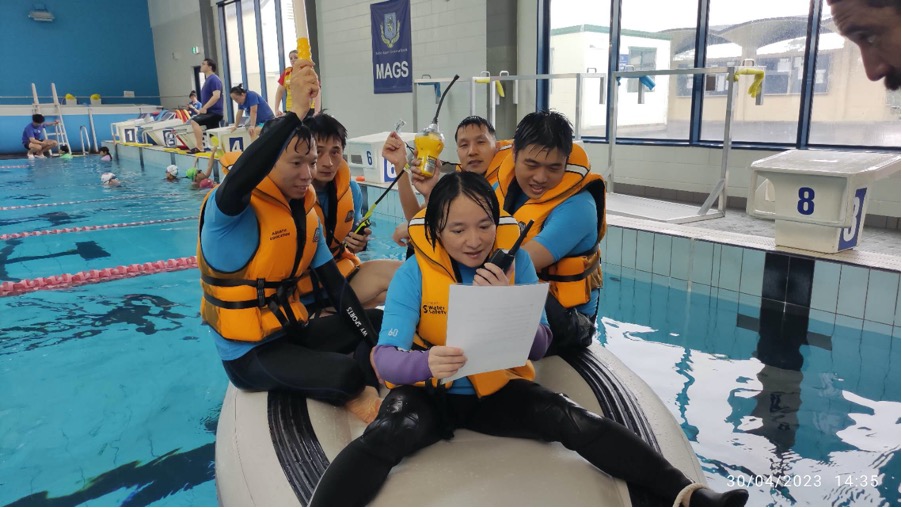
One of DPA’s flagship programmes, Wai Wise, ran for the first time with Auckland’s Asian community last month.
The programme provides an insight of water safety learning through both theory sessions and a series of practical workshops to improve water competence, survival and safety skills. Over twenty participants from Chinese Dragon Boat Association (CDBA) nicknamed the Dragon Riders, took part. over several weekends. . Whilst participants joined with boating experience from paddling dragon boats, they lacked water safety knowledge and experience.
DPA partnered with Coastguard Boating Education (CBE) who supported the courses on Day Skipper and In-water Survival.
Shan Shan Xu
Global water safety and drowning prevention event – Vector Wero Whitewater Park

Last month, Vector Wero hosted a global water safety and drowning prevention event in collaboration with several key partners in the aquatics industry. The event provided members of the public with free in-water experiences, lessons and resources to keep themselves safer in on and around the water. The activities included white water rafting, stand up paddleboarding, canoe polo and kayaking.
It was fantastic to see such high levels of engagement with hundreds of people learning and having fun.
The DPA team provided guidance and information on Auckland’s navigational safety bylaws, lifejacket use, pool safety messaging and ran a real time demonstration of the 4R’s for bystander rescue. The demonstration teaches members of the public how to assist people in the water without putting themselves at risk. This is an important skill to learn as statistics show us that 3% of rescuers who enter the water to save somebody in distress end up drowning themselves.
- Recognition This emphasises the importance of recognising when someone is at risk of drowning and taking action to prevent it. This includes being aware of the signs of distress, such as gasping for air or struggling to stay afloat and taking immediate action to assist them. It is also important to keep an eye on those who are swimming or playing in the water, particularly children or those who may not be strong swimmers.
- Respond If someone is in danger of drowning, the next step is to respond quickly. This may involve alerting others in the area, such as lifeguards, other swimmers or calling 111 and asking for the police. It is important to remember that time is of the essence in a drowning situation, so any delay in responding could have serious consequences.
- Rescue The next step is to rescue the person in danger. This may involve using tools around you including, flotation devices, water bottles, sticks, throwing a rope or other objects to the person which will assist in keeping them afloat until they are able to swim to shore or until help arrives.
- Resuscitation Finally, once the person has been rescued, it is important to revive them if necessary. This may involve performing CPR at a rate of 30 compressions and two breaths or other lifesaving techniques like the recovery position until emergency responders arrive.
Complete the free Bystander Rescue lesson within the Water Safety for Youth and Young Adults eLearning module.


For more information about events, contact Harry Aonga – Team Leader Community Education & Events: Harry.aonga@dpanz.org.nz or on 0211118674.
April 2023 SPLASH Holiday Programme

SPLASH originally started as a weeklong holiday programme and has has now been re-designed to to run in one day – a day filled with new learnings and water safety experiences.
During the school holidays, SPLASH took place at Mount Albert Aquatic Centre, offering two daylong programmes for around 30 children aged 8-10 and11-13 year olds. The programme covers many aspects around the water, with some of these being, lifejacket safety, boating safety, recognising, and assisting a drowning person and beach safety.
The children thoroughly enjoyed all of the activities with the highlights being the snorkelling and safer boating. The safer boating activity not only taught them what to do and what to wear when on a boat, but it also developed their teamwork and leadership skills.
The children really enjoyed the programme and left with a whole new set of skills. Many were keen to return for the next holidays!
Other news
Award Finalists Announced
We have great pleasure in announcing the finalists in the inaugural Drowning Prevention Auckland 'Water Safety Champion Awards 2017'. Our heartiest congratulations to all the finalists, winners will be announced at the our AGM, 4pm-6pm, Thursday 30 November 2017....
Water Safety Champion Awards
Who do you know? We are pleased to announce the inaugural Drowning Prevention Auckland* 'Water Safety Champion Awards 2017' in recognition of individuals, community groups, organisations or businesses that have demonstrated commitment, initiative and leadership in the...

Safety advice helps save fisher’s life
Crab fishing is becoming more popular, particularly at Northland beaches such as Uretiti and Waipu, where there have been three drownings since 2011. In an effort to prevent further loss of life WaterSafe Auckland joined forces with Surf Life Saving Northern and the...