2022 Spring Forum Overview

2022 Spring Forum Overview

In September our Spring Forum brought together sector leaders, research, and industry experts to share and discuss some of the key findings arising from PRE research and related water safety projects.

Dr Kevin Moran, DPA set the scene around the problems and practices worldwide which highlighted some of the similar issues and procedures to New Zealand, whilst identifying considerations for solutions. He was clear on role of PRE during a rescue was to ‘interrupt the chain of survival and buy time’. He also provided findings and updates on behaviours of Rock-based fishers from data spanning back to 2011.

Dr Teresa Stanley, DPA and Dr Mick Kearney, SLSNZ shared the current findings from our collaborative PRE project funded by NZSAR. The project aims to produce national guidelines that helps coastal managers and emergency services make better-informed decisions about PRE requirements and educate on their use.

Dr Stanley shared the results from a trial of testing accuracy of throw for the various proposed PRE to see which would be best suited for various locations. Results showed that for the majority of the population, throwing efficiency of most PRE is very limited. Dr Kearney shared the research into the identified signage issues and researched options, including a case study from South Africa.

Ants Lowe discussed the findings from our freshwater hazard assessments (outlined above) and introduced Holly Foreman from Safeswim, Auckland Council to discuss the new pins and share further information about the WHO recognised platform. The platform allows people to check water safety and water quality before they swim with the number of sites around New Zealand (including beach and freshwater) continuing to grow.

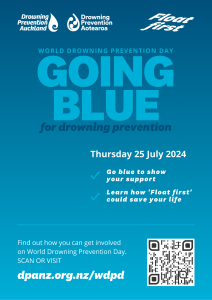
Grief and healing the focus of World Drowning Prevention Day, with dawn memorial planned for Tāmaki Makaurau

Grief and healing the focus of World Drowning Prevention Day, with dawn memorial planned for Tāmaki Makaurau

MEDIA RELEASE | 21 July 2022

A very special commemoration to honour those who have lost their lives to drowning is planned for Monday 25 July 2022.

This event held at St Mary’s Bay, Tāmaki Makaurau, will provide healing for people who are grieving the loss of a special person in their lives. Rihari Wilson, who mourns the loss of his father and brother to drowning will speak on behalf of grieving families and raise awareness of the importance of water safety education so people can enjoy the water safely.

In the evening, the Sky Tower will light up blue as other nations across the world commence their tributes.

Drowning Prevention Auckland says this is a sad but important day for those families in Aotearoa and globally who have lost loved ones through drowning. But it is also a day of hope. In New Zealand, drownings are largely preventable and water safety education is the key to improving people’s knowledge, attitudes and behaviour around water.

“The water safety sector in New Zealand is united as one voice to raise awareness that anyone can drown, no one should”, says Drowning Prevention Auckland chief executive, Nicola Keen-Biggelaar.

“This year alone, since New Year’s Day, 10 people have drowned in the Auckland region. In the last five years, drowning took the lives of 85 people locally (2017 – 2021)*. All 85 deaths were preventable leaving 85 families devastated.

“With warmer water this past summer, we’ve noticed more people visiting beaches, going out on boats, playing on new toys like paddleboards and kayaks. Yet we also saw more people get into strife and overestimate their current level of fitness or be willing to take more risks after going through extended lockdowns.”

Auckland Councillor and Parks, Arts, Community and Events Chairperson Alf Filipaina says that the impact of drowning deaths on the community really brings home the need to mark this day: “Too many people lose their lives through drowning. Communities are fractured with the loss of loved ones. This day remembers but also highlights we must do all we can to prevent families and communities losing their whānau and friends.”

Drowning affects every nation of the world. In New Zealand, the drowning rate is disproportionately high compared to other OECD countries.

In April 2021, the United Nations General Assembly adopted the first ever Resolution on drowning prevention, acknowledging the issue for the first time in its 75-year history. New Zealand, along with over 80 countries worldwide, including Australia and some Pacific Nations, co-sponsored this historic resolution, which was initiated by Bangladesh and Ireland.

“Drowning is a preventable public health problem. As an organisation dedicated to saving lives in, on and around water, Drowning Prevention Auckland takes positive and practical action to promote and teach people water safety skills to help keep Kiwis safe around water”, says Keen-Biggelaar.

Drowning Prevention Auckland is one of Tāmaki Makaurau’s lead water safety education providers delivering water safety education and rescue training into the community and digitally through their free online education portal. Their drowning prevention strategies and education programmes are reaching into diverse communities, and across preschools and schools to teach people to enjoy the water safely.

Keen-Biggelaar is thrilled to have the collective support of members of the water safety sector and the public attend the commemorations at St Mary’s Bay at dawn (7am) on 25 July.

“This acknowledges the important work we are all doing to promote and deliver life saving education so families can celebrate their water experiences.” says Keen- Biggelaar.

*Auckland Region and New Zealand drowning Preventable deaths 1 Jan 2017 – 31 Dec 2021 Report. (Water Safety New Zealand).

Photo credit: The Hui (Newshub)
Lifejacket Use and Maintenance

Lifejacket Use and Maintenance

Calling Tāmaki Makaurau Auckland home means living in a city surrounded by many beautiful water environments. Recreational activities on or near the water are common, everywhere from our lakes and rivers, to our harbours and rugged west coast beaches.

Along with the health and wellbeing benefits these water-based activities bring, also comes the risk of drowning. A tragic and preventable event that can affect anyone.

The Maritime NZ Boating Fatality Report notes 98 recreational boating fatalities in the six years 2015-2019. Over half (58%) were not wearing a lifejacket, and in a further 9% the lifejackets were not worn or secured correctly. The report states that most fatalities occurred when the person ended up in the water after falling overboard, or the vessel capsizing or being swamped. The incidents occurred suddenly and the victims did not have time to fit lifejackets if they were not already being worn.

Whether you are boating, fishing, paddling, or gathering seafood, it is important that you know when and how to wear a lifejacket (sometimes referred to as a PFD – Personal Flotation Devices).

When do you need to wear a lifejacket?

Bylaws on the wearing of lifejackets vary. Click the button to check the rules about when you need to wear a lifejacket (Ture ā-Rohe Mahi Urungi Āhuru 2021 Navigation Bylaw 2021)

How to fit a lifejacket

It is absolutely essential that your lifejacket is correctly fitted. It should fit snugly and shouldn’t ride up when the person enters the water.
Out of the water
  • Read the label on the lifejacket to find the right fit. Select the correct lifejacket by size and weight indicators.
  • Check belt straps are not twisted.
  • Put it on and do up the zip, if applicable, and each buckle so that it is a snug fit.
  • Self check the belt by inserting two fingers between the belt and the lifejacket.
  • Buddy check by lifting at the shoulders to ensure the lifejacket doesn’t ride up past earlobes.
In the water
You may need to do this in emergency situations such as accidental falls from a boat not wearing a lifejacket or if thrown a lifejacket as a rescue aid.

  • Open lifejacket and lie it face up in the water.
  • Lie on top of the lifejacket, without putting arms through the armholes.
  • Put one arm through the opposite armholes.
  • Rotate body and put other arm through other armhole.

Maintaining lifejackets

Not only should you have a correctly fitted lifejacket for every person taking part in the water-based activity, these lifejackets should be in good condition.

Most manufacturers state that lifejackets should last ten years, but this can be less depending on wear, care, and storage.

Wash in fresh water, and dry completely before storing. Check for damage before you put your lifejackets away.

Check if your lifejacket will work:

  • Pull the straps, hard.
  • Look for tears or cuts in the straps.
  • Check for tears, cuts, or punctures in the lifejacket.
  • Check if it floats – Check with the manufacturer or lifejacket service centre.

For more information on checking lifejackets visit the Check your lifejackets page of the Maritime NZ website.

If you have an inflatable lifejacket we advise you to perform this check annually to ensure your lifejacket is operational.

Don’t have a lifejacket? Borrow one from us!

If you need a lifejacket for an upcoming activity and don’t have one, then you can borrow one from one of our Lifejacket Hubs around Tāmaki Makaurau. Click the button for locations and to find out more.

Lifejackets for schools

We have a supply of lifejackets available, free of charge, for aquatic education programmes. Click the button for more information.

Free e-learning platform

Our free e-learning platform has several topics relating to the usage of lifejackets for various ages and activities.
Spring Forum 2022

Spring Forum 2022

WHEN 1pm to 5pm, Tuesday 20 September, 2022
WHERE Hyundai Marine Sports Centre, 8/10 Tamaki Drive, Auckland
RSVPTo isla.mcniel@dpanz.org.nz by Tuesday 13 September

Come along to hear about:

5
How research is informing the development of national PRE guidelines and how this can provide safer environments and opportunities for safer bystander rescue.
5
How risk assessment of freshwater sites is achieved and how it is being used by Safeswim to increase public safety.

Speakers

Dr Kevin Moran (DPA)

Public Rescue Equipment – the problems and practice worldwide

Dr Mick Kearney (SLSNZ) & Dr Teresa Stanley (DPA)

Public Rescue Equipment and the establishment of national guidelines

Ants Lowe (DPA)

Freshwater hazard assessment

Holly Foreman (Auckland Council)

Safeswim platform

SUP Safety

SUP Safety

Stand up paddle boarding is a popular activity for people of all ages and activity levels. This means that there is a wide range in the level of ability and confidence amongst paddle boarders. We want everyone to be able to safely enjoy this water sport which is great for fitness and overall wellbeing. Here are the key things you can do to keep yourself safe while out on your SUP.
Use a leash
Make sure you know and use the right leash for the conditions. This varies depending on which type of body of water you are in. Rivers and currents have different requirements to lakes, which differs again to surf.
Wear a correctly-fitted lifejacket

Sometimes referred to as a PFD (personal flotation device) or buoyancy aid, a lifejacket is an essential item when out on the water. Ensure your lifejacket, and that of anyone you are paddling with, is correctly fitted. If you don’t have a lifejacket you can borrow one from us from one of our Auckland Lifejacket Hubs.

2+ waterproof forms of communication
Always take at least two forms of waterproof communication with you in case you need to call for help. This can include a mobile phone in a waterproof bag and a whistle on your lifejacket.
Check the conditions and be prepared for them to change
Weather and water conditions can change quickly. Check the forecast before you go and be prepared for the conditions to change while you are out paddling.
Tell someone your plan
Before you head out, tell someone on shore where you are going and when you expect to return.

Check out this video from our friends at New Zealand Stand Up Paddle which covers these key points. They go more indepth in aspects of SUP safety on their website.

Adult Water Safety e-learning

Learn more about staying safe while enjoying water-based activities by completing our Adult Water Safety e-learning module.