World first lifejacket initiative

Lifejackets accessible at high-risk location in world first initiative

At the end of November, Drowning Prevention Auckland (DPA) installed a remote Lifejacket Station at Te Henga Bethells Beach in partnership with local iwi Te Kawarau ā Maki.

In this global first of its kind initiative DPA worked closely with mana whenua to make lifejackets available to anyone enjoying water-related activities at Te Henga Bethells, particularly those fishing from the rocks.

“Collaborating with Te Kawarau ā Maki has been fantastic. By working within their mātaraunga, respecting the environment and learning about the historical significance of this land, we’ve enabled easy access to lifejackets, which will directly save the lives of rock-based fishers. This pilot project is a special way to support Te Kawarau ā Maki in their guardianship of the people and the land.” Ants Lowe, DPA.

The lifejackets are situated on iwi land in a location that is easily accessible to the rocks and are stored in a unit that was designed to blend in with the landscape it sits within. The pilot station was installed with thought to there being no long-term negative impact on the environment, and the colour palette was carefully considered to co-exist with the surroundings. The artwork on the station includes designs from local iwi Te Kawarau ā Maki and simple graphic instructions showing how to use the station.

“Te Kawerau ā Maki support this kaupapa as part of our enduring responsibility to protect our people, our manuhiri, and our whenua. Te Henga is of deep cultural significance to our iwi and is where we will rebuild our marae and return our people home, so partnering with DPA to establish this initiative in our heartland was a natural fit. This lifejacket station reflects our shared commitment to protecting lives and ensuring everyone can return safely to their whānau, and it strengthens our ability to support those who fish, gather, or enjoy the moana here in a way that upholds our role as kaitiaki of this rohe”. Ashleigh McDonald, Te Kawarau ā Maki.

The borrow, wear, and return system allows easy access to good quality, fit for purpose lifejackets that people can use at no charge while fishing from the rocks or participating in any activity where they are at risk of falling in the water.

The station at Te Henga is a pilot aimed at saving lives and if successful, DPA would like to see these as commonplace in high risk environments. 20 years of research has shown this location and others like it have a high risk of death by drowning for fishers. The wearing of lifejackets, along with education in safer fishing practices, decreases the risk of further fatalities.

For tips on safer rock-based fishing and more useful resources visit this link.

Click to complete our free online learning module.

Other news

Activating water safety in the community

Activating water safety in the community

Over the past month, Drowning Prevention Auckland has actively promoted water safety education to people of all ages and experiences across a variety of settings. Highlights include the Wai Wise workshop for Asian and Pasifika communities, lifeguard training at Mt...

School adds water safety into outdoor education

School adds water safety into outdoor education

Education Outside the Classroom (EOTC) provides the perfect opportunity for students to develop aquatic competencies. Bringing learning to life and finding out first-hand how to stay safer in, on and around the water. Drowning Prevention Auckland (DPA) works with...

World first lifejacket initiative

Lifejackets accessible at high-risk location in world first initiativeAt the end of November, Drowning Prevention Auckland (DPA) installed a remote Lifejacket Station at Te Henga Bethells Beach in partnership with local iwi Te Kawarau ā Maki. In this global first of...

Summer pool safety

Take five minutes today - it might save a life tomorrowSummer’s here and that means long days, warm nights, and plenty of time in the pool. But, each summer, New Zealand families are devastated by preventable drownings in home pools. In Aotearoa New Zealand, an...

No two days the same for Aquatic Educator

No two days the same: A month in the life of an Aquatic EducatorWhen people think about water safety education, they often picture someone standing poolside, teaching basic swimming and survival skills. For Aquatic Educator Danika Ryland-Higgins, it looks very...

Summer pool safety

Take five minutes today – it might save a life tomorrow

Summer’s here and that means long days, warm nights, and plenty of time in the pool.

But, each summer, New Zealand families are devastated by preventable drownings in home pools.

In Aotearoa New Zealand, an average of two pre-schoolers lose their lives in home pool drownings each year.

Every one of these deaths is one too many – and we all have a part to play in reducing that number to zero.

Four steps you can take to make your pool safer

Did you know it takes just five minutes to make your pool safer? Here’s four simple steps you can take today:

● Ensure the pool gate and lock are working and close properly.
● Trim plants that could be used to climb over fences.
● Remove ladders from around the pool area.
● Never leave pool gates propped open.

Supervision is key

Active supervision of children is essential in preventing drownings.

A child can drown in less than five centimetres of water in under 30 seconds.

Children should always be within sight, and children under five should be within arm’s reach at all times.

At social events, we recommend having one dedicated adult who is responsible for watching the children in and around the water. This is even more important during barbecues and food preparation when people can become distracted.

It’s easy to assume someone else is watching the pool – so making it one person’s job is the safest option.

Own a pool? Here are the rules you need to follow

  • All residential swimming pools must have compliant barriers to prevent unsupervised access by children under five years of age.
  • Portable or inflatable pools that can hold 400mm or more of water must also have compliant barriers.
  • Portable pools should be supervised at all times and emptied after use.
  • Pool barrier requirements apply regardless of whether any children live at a property.
  • Pools, including freestanding pools and swim spas, installed after 1 January 2017, are not permitted to use removable ladders unless they are enclosed by a compliant barrier and gate.
  • Residential pools must be inspected every three years.

Find a pool safety checklist for parents / caregivers here.

So, take five minutes to check your pool, supervise children in and around pools, and let’s make this summer safe and enjoyable for everyone.

Take our free course

To support families in teaching their children how to be safe in the water, we offer free online training over on our eLearning platform.

Useful resources

Drowning Prevention Auckland
Auckland Council pool area safety checklist
Water Safety New Zealand staying safe: swimming pools

Other news

Activating water safety in the community

Activating water safety in the community

Over the past month, Drowning Prevention Auckland has actively promoted water safety education to people of all ages and experiences across a variety of settings. Highlights include the Wai Wise workshop for Asian and Pasifika communities, lifeguard training at Mt...

School adds water safety into outdoor education

School adds water safety into outdoor education

Education Outside the Classroom (EOTC) provides the perfect opportunity for students to develop aquatic competencies. Bringing learning to life and finding out first-hand how to stay safer in, on and around the water. Drowning Prevention Auckland (DPA) works with...

World first lifejacket initiative

Lifejackets accessible at high-risk location in world first initiativeAt the end of November, Drowning Prevention Auckland (DPA) installed a remote Lifejacket Station at Te Henga Bethells Beach in partnership with local iwi Te Kawarau ā Maki. In this global first of...

Summer pool safety

Take five minutes today - it might save a life tomorrowSummer’s here and that means long days, warm nights, and plenty of time in the pool. But, each summer, New Zealand families are devastated by preventable drownings in home pools. In Aotearoa New Zealand, an...

No two days the same for Aquatic Educator

No two days the same: A month in the life of an Aquatic EducatorWhen people think about water safety education, they often picture someone standing poolside, teaching basic swimming and survival skills. For Aquatic Educator Danika Ryland-Higgins, it looks very...

No two days the same for Aquatic Educator

No two days the same: A month in the life of an Aquatic Educator

When people think about water safety education, they often picture someone standing poolside, teaching basic swimming and survival skills. For Aquatic Educator Danika Ryland-Higgins, it looks very different.

This story is a snapshot of just one month in Danika’s life as an educator with Drowning Prevention Auckland. In that time, she might teach pool lifeguards and engineers, support refugee communities, work with rangatahi in the ocean, and visit yacht clubs and community events. Much of this happens in the water, outdoors and on the move, and almost never behind a desk.

Before joining DPA, Danika was a First Aid Instructor with New Zealand Red Cross. She has long been at home in, on and under the water as a surf lifeguard, competitive swimmer, free diver, fisher and scuba diver. That mix of skills means she is just as comfortable coaching confidence in the deep end as she is supporting people through their first ever experience of Aotearoa New Zealand’s waterways.

Early one morning you will find Danika at a pool before opening hours, running an aquatics-based first aid session for lifeguards and pool staff.

Across a focused workshop, she helps teams refresh critical skills such as CPR, using a defibrillator and responding calmly when something goes wrong in or beside the water. The goal is simple: when an emergency happens, staff feel ready, not rattled. The same principles apply in workplaces where people spend time in, on or around the water. From staff who supervise aquatic activities to teams whose work takes them near waterways, Danika helps people understand risks, recognise trouble early and respond effectively.

Another day, she might be at Wero Whitewater Park, a controlled river environment in Tāmaki Makaurau, working with a team whose job brings them close to fast-moving water.

Here, the focus is on survival and helping each other if someone ends up in the river unexpectedly. Participants learn how to stay calm and Float first, move with the water rather than fight it, and use simple rescue techniques to support teammates from the safety of the bank. It is physical, practical and eye-opening, especially for people who have not experienced cold, fast water before.

The next week, Danika may be standing in front of 84 refugees at the Māngere Refugee Resettlement Centre, supported by a team of 12 translators.

Many of the people in the room have come from landlocked countries or have never been to a beach. Danika adapts her teaching style by slowing down, shortening sentences and using stories and demonstrations so that key safety messages are clear in every language. She knows this work may save lives. For people who are new to Aotearoa New Zealand, understanding rip currents, unexpected immersion and how to get back to safety can be the difference between a close call and a tragedy.

Outside of the resettlement centre, you will find her with community groups across the city in yacht clubs, faith communities, corrections facilities and more, tailoring “Be Water Safe” workshops to each audience.

Danika also spends some days supporting our team to deliver RUKU: Tau ihu in the open water with rangatahi at Te Kohuroa Mathesons Bay.

Here, water safety is woven together with connection to place and respect for te taiao. Rangatahi experience the ocean directly, learning to Float first, understand their own abilities and build confidence in, on and around the moana.

When she is not in a pool, river, classroom, or bay chances are Danika is out in the community at events and festivals such as Splashy Bikers Nature Day or Have a Throw Day, chatting with tamariki, whānau and community members at the DPA stand. It is all part of the same mission: helping more people enjoy Aotearoa New Zealand’s waters safely, for life.

We regularly hear feedback like:

My instructor was attentive, informative, and accommodated all our needs while encouraging us to challenge ourselves.

That balance of being supportive and stretching people just enough is at the heart of how Danika and our aquatic education team work.

If you are a workplace wanting to keep your people safe around water, or a community group keen to build water confidence and skills, our team can help.

Learn more about workplace training and book.

Explore Be Water Safe for community groups and enquire.

With Aquatic Educators like Danika on the job, one thing is for sure: even in a single month, no two days, and no two groups, are ever the same.

Do you have what it takes to be an Aquatic Educator?

We’re hiring! Click to find out more about the role and apply today.

Other news

Activating water safety in the community

Activating water safety in the community

Over the past month, Drowning Prevention Auckland has actively promoted water safety education to people of all ages and experiences across a variety of settings. Highlights include the Wai Wise workshop for Asian and Pasifika communities, lifeguard training at Mt...

School adds water safety into outdoor education

School adds water safety into outdoor education

Education Outside the Classroom (EOTC) provides the perfect opportunity for students to develop aquatic competencies. Bringing learning to life and finding out first-hand how to stay safer in, on and around the water. Drowning Prevention Auckland (DPA) works with...

World first lifejacket initiative

Lifejackets accessible at high-risk location in world first initiativeAt the end of November, Drowning Prevention Auckland (DPA) installed a remote Lifejacket Station at Te Henga Bethells Beach in partnership with local iwi Te Kawarau ā Maki. In this global first of...

Summer pool safety

Take five minutes today - it might save a life tomorrowSummer’s here and that means long days, warm nights, and plenty of time in the pool. But, each summer, New Zealand families are devastated by preventable drownings in home pools. In Aotearoa New Zealand, an...

No two days the same for Aquatic Educator

No two days the same: A month in the life of an Aquatic EducatorWhen people think about water safety education, they often picture someone standing poolside, teaching basic swimming and survival skills. For Aquatic Educator Danika Ryland-Higgins, it looks very...

We All Play a Part this Water Safety Month

We All Play a Part this Water Safety Month

We All Play a Part This Water Safety Month


November is New Zealand’s Water Safety Month, and this year’s theme is “We All Play a Part”.

Water Safety New Zealand will shine a spotlight on the contributions of individuals, whānau, and communities in drowning prevention efforts across the motu. They’ll feature local champions, including surf clubs, fishing clubs, iwi, schools, and community groups.

Drowning Prevention Auckland (DPA) will also join in. In fact, this blog is all about the education, research and advocacy work we can achieve when we work together.

So, let’s take this time to acknowledge and celebrate our collaborations with sector partners, iwi, community groups, marae, and retailers. The support of others means we can offer low-cost and free resources and programmes to reach the most at-risk communities.

Together, we can all make a difference and create a stronger water safety culture in Tāmaki Makaurau Auckland and beyond – so that everyone can enjoy the water and return home safely.

Float first: sharing a lifesaving message that’s simple to remember and backed by research

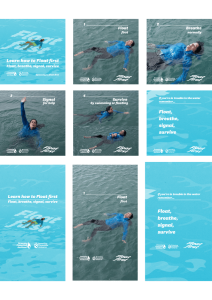
Thanks to the support of our sector partners, Coastguard Tautiaki Moana, Surf Life Saving NZ, Maritime NZ, and New Zealand Search and Rescue, DPA developed the Float first survival steps (building on the RNLI’s Float to Live campaign and research by the University of Portsmouth).

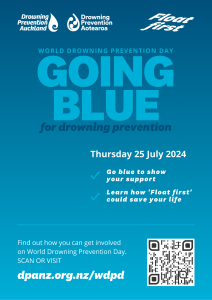
Working together, we’ve been sharing this lifesaving message across Aotearoa New Zealand as part of World Drowning Prevention Day over the last four years.

Float first has become central to our messaging, and for good reason. In moments of difficulty in the water, many panic or attempt to swim, immediately increasing their risk of cold-water shock, exhaustion and drowning.

Instead, if you float, your body has the chance to calm down, save energy, and signal for help.

If you find yourself in trouble in the water, follow the four steps of Float first – float, breathe, signal, survive.

You can read more about Float first and watch a video demonstrating the four steps here.

Fishing safely from the rocks: Celebrating a 20-year partnership with Surf Life Saving Northern Region and Auckland Council

Thanks to an incredible partnership with Surf Life Saving Northern Region and Auckland council, we celebrated an amazing milestone this year: 20 years of our West Coast Rock-Based Fishers project.

As part of this project, we’ve been researching and tracking activity, behaviours and attitudes among rock-based fishers. This research allows us to deliver targeted and culturally appropriate education to keep people fishing from the rocks and land safe.

We continue to connect with the fishing community. We’re now working with New Zealand Sport Fishing Council and have a full-time advisor at Auckland’s West Coast beaches.

In recent years, with thanks to Auckland Council, we’ve been able to expand our impact by creating and sharing digital and printed materials based on the five tips of the Water Safety Code. We’ve also delivered educational sessions to reach at-risk communities.

Read more about rock-based fishing.

DPA Lifejacket Hubs: Partnering with the community to improve access

Like following the four steps of Float first, wearing a correctly fitted lifejacket – that’s in good condition – can mean the difference between life and death.

That’s why we partner with community-based organisations to make it easier for people to borrow free, well-fitted lifejackets, whether that’s for rock-based fishing, boating, kayaking or something else. These hubs are especially important for families and groups who may not be able to afford or store their own safety gear.

We have nine locations across Tāmaki Makaurau Auckland, as well as three hubs across the country – Glenorchy, Whangamatā and Waikato.

View all the DPA Lifejacket Hub locations here and please take the time to fill out our Lifejacket Use Survey after you borrow a lifejacket. The information you supply helps us provide evidence for funding accountability reports and new funding applications to enable us to maintain our Lifejacket Hubs.

The Water Safety Code: A five-step framework to make better decisions

As part of our advocacy work, we’ve developed the Water Safety Code alongside our sector partners, Surf Life Saving NZ, Maritime NZ, Water Safety New Zealand, and New Zealand Search and Rescue.
The Water Safety Code was a collaborative effort to develop five simple tips to help everyone stay safe and make good decisions in, on and around water – regardless of location or activity.
The five tips – designed to be easy to remember and share – are:

  1. Know how to float
  2. Find the safest place
  3. If in doubt, stay out
  4. Take care of yourself and others
  5. Know how to get help

If you’d like to download Water Safety Code posters (available in English and te reo Māori) and share these important messages with your friends, whānau and workplace, please visit this link.

RUKU: Tau Ihu. A hugely popular initiative co-created with Rihari Wilson of Te Ahiwaru Trust

Across all our education, research and advocacy initiatives, we’re focused on upholding Te Tiriti o Waitangi and being a responsible treaty partner.

One way we do this – while reaching an at-risk population – is through the highly popular RUKU: Tau Ihu programme.

Now in its third year, RUKU: Tau Ihu, co-created by Rihari Wilson of Te Ahiwaru Trust and DPA’s Ants Lowe, is oversubscribed. Around 200 rangatahi completed the programme last year, and we’ve now got a waitlist.

RUKU brings together theory, in-pool sessions and open-water dives to teach rangatahi how to be safe in the water, while connecting or reconnecting them with mātauranga Māori (Māori worldview, values and culture).

Be Water Safe: Connecting with marae, schools and community centres

A programme which is especially impactful for new migrants and international students – groups who are often unfamiliar with our unique aquatic environments – Be Water Safe is about accessing free or low-cost water safety education.

Thanks to connections through schools, community centres and marae, Be Water Safe allows us to reach people who are at risk of drowning. These short and informative sessions focus on building respect for the water, understanding local risks, and learning how to make safer decisions in, on and around water.

We’re thrilled to share that sessions are now available in-person in Tāmaki Makaurau Auckland.

We’d love for you to get in touch if you’re interested in booking an in-person or digital session.

Want to play your part?

We all have a part to play in keeping ourselves and each other safe in, on and around the water.

A great place to start is Be Water Safe.

Please get in touch to find out more and to book a Be Water Safe session for your community.

Water Safety New Zealand now have resources for this year’s campaign available – including a digital sticker that you can share on social media. We encourage you to share your stories or shine a light on individuals or groups contributing to water safety using the hashtag #weallplayapart.

Other news

Activating water safety in the community

Activating water safety in the community

Over the past month, Drowning Prevention Auckland has actively promoted water safety education to people of all ages and experiences across a variety of settings. Highlights include the Wai Wise workshop for Asian and Pasifika communities, lifeguard training at Mt...

School adds water safety into outdoor education

School adds water safety into outdoor education

Education Outside the Classroom (EOTC) provides the perfect opportunity for students to develop aquatic competencies. Bringing learning to life and finding out first-hand how to stay safer in, on and around the water. Drowning Prevention Auckland (DPA) works with...

World first lifejacket initiative

Lifejackets accessible at high-risk location in world first initiativeAt the end of November, Drowning Prevention Auckland (DPA) installed a remote Lifejacket Station at Te Henga Bethells Beach in partnership with local iwi Te Kawarau ā Maki. In this global first of...

Summer pool safety

Take five minutes today - it might save a life tomorrowSummer’s here and that means long days, warm nights, and plenty of time in the pool. But, each summer, New Zealand families are devastated by preventable drownings in home pools. In Aotearoa New Zealand, an...

No two days the same for Aquatic Educator

No two days the same: A month in the life of an Aquatic EducatorWhen people think about water safety education, they often picture someone standing poolside, teaching basic swimming and survival skills. For Aquatic Educator Danika Ryland-Higgins, it looks very...

Be Water Safe

Be Water Safe

A short education session designed to give participants the essential water competence knowledge and understanding they need to feel more confident and safely enjoy everyday situations at the beach, pool, or near water in your community.

Key points covered in the session are:

  • Snapshot of the 15 water competencies for drowning prevention
  • Float first survival response
  • Using lifejackets
  • Access to free resources or opportunities to further develop knowledge and skills.

Choose a 15, 30, or 60 minute session.

Other news

Activating water safety in the community

Activating water safety in the community

Over the past month, Drowning Prevention Auckland has actively promoted water safety education to people of all ages and experiences across a variety of settings. Highlights include the Wai Wise workshop for Asian and Pasifika communities, lifeguard training at Mt...

School adds water safety into outdoor education

School adds water safety into outdoor education

Education Outside the Classroom (EOTC) provides the perfect opportunity for students to develop aquatic competencies. Bringing learning to life and finding out first-hand how to stay safer in, on and around the water. Drowning Prevention Auckland (DPA) works with...

World first lifejacket initiative

Lifejackets accessible at high-risk location in world first initiativeAt the end of November, Drowning Prevention Auckland (DPA) installed a remote Lifejacket Station at Te Henga Bethells Beach in partnership with local iwi Te Kawarau ā Maki. In this global first of...

Summer pool safety

Take five minutes today - it might save a life tomorrowSummer’s here and that means long days, warm nights, and plenty of time in the pool. But, each summer, New Zealand families are devastated by preventable drownings in home pools. In Aotearoa New Zealand, an...

No two days the same for Aquatic Educator

No two days the same: A month in the life of an Aquatic EducatorWhen people think about water safety education, they often picture someone standing poolside, teaching basic swimming and survival skills. For Aquatic Educator Danika Ryland-Higgins, it looks very...