Highlights from our April activity including Wai Wise, a global drowning prevention event at Vector Wero Whitewater Park and the new one-day SPLASH holiday programme.
Wai Wise Programme
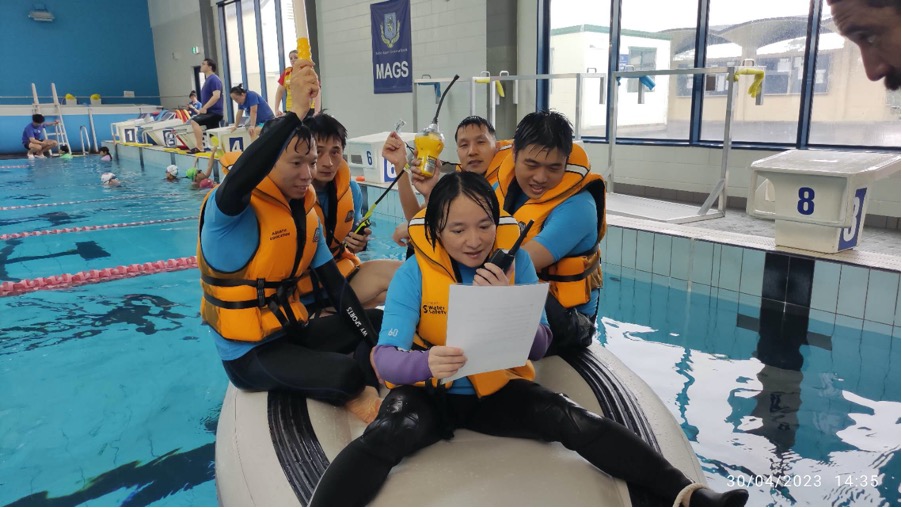
One of DPA’s flagship programmes, Wai Wise, ran for the first time with Auckland’s Asian community last month.
The programme provides an insight of water safety learning through both theory sessions and a series of practical workshops to improve water competence, survival and safety skills. Over twenty participants from Chinese Dragon Boat Association (CDBA) nicknamed the Dragon Riders, took part. over several weekends. . Whilst participants joined with boating experience from paddling dragon boats, they lacked water safety knowledge and experience.
DPA partnered with Coastguard Boating Education (CBE) who supported the courses on Day Skipper and In-water Survival.
Shan Shan Xu
Global water safety and drowning prevention event – Vector Wero Whitewater Park

Last month, Vector Wero hosted a global water safety and drowning prevention event in collaboration with several key partners in the aquatics industry. The event provided members of the public with free in-water experiences, lessons and resources to keep themselves safer in on and around the water. The activities included white water rafting, stand up paddleboarding, canoe polo and kayaking.
It was fantastic to see such high levels of engagement with hundreds of people learning and having fun.
The DPA team provided guidance and information on Auckland’s navigational safety bylaws, lifejacket use, pool safety messaging and ran a real time demonstration of the 4R’s for bystander rescue. The demonstration teaches members of the public how to assist people in the water without putting themselves at risk. This is an important skill to learn as statistics show us that 3% of rescuers who enter the water to save somebody in distress end up drowning themselves.
- Recognition This emphasises the importance of recognising when someone is at risk of drowning and taking action to prevent it. This includes being aware of the signs of distress, such as gasping for air or struggling to stay afloat and taking immediate action to assist them. It is also important to keep an eye on those who are swimming or playing in the water, particularly children or those who may not be strong swimmers.
- Respond If someone is in danger of drowning, the next step is to respond quickly. This may involve alerting others in the area, such as lifeguards, other swimmers or calling 111 and asking for the police. It is important to remember that time is of the essence in a drowning situation, so any delay in responding could have serious consequences.
- Rescue The next step is to rescue the person in danger. This may involve using tools around you including, flotation devices, water bottles, sticks, throwing a rope or other objects to the person which will assist in keeping them afloat until they are able to swim to shore or until help arrives.
- Resuscitation Finally, once the person has been rescued, it is important to revive them if necessary. This may involve performing CPR at a rate of 30 compressions and two breaths or other lifesaving techniques like the recovery position until emergency responders arrive.
Complete the free Bystander Rescue lesson within the Water Safety for Youth and Young Adults eLearning module.


For more information about events, contact Harry Aonga – Team Leader Community Education & Events: Harry.aonga@dpanz.org.nz or on 0211118674.
April 2023 SPLASH Holiday Programme

SPLASH originally started as a weeklong holiday programme and has has now been re-designed to to run in one day – a day filled with new learnings and water safety experiences.
During the school holidays, SPLASH took place at Mount Albert Aquatic Centre, offering two daylong programmes for around 30 children aged 8-10 and11-13 year olds. The programme covers many aspects around the water, with some of these being, lifejacket safety, boating safety, recognising, and assisting a drowning person and beach safety.
The children thoroughly enjoyed all of the activities with the highlights being the snorkelling and safer boating. The safer boating activity not only taught them what to do and what to wear when on a boat, but it also developed their teamwork and leadership skills.
The children really enjoyed the programme and left with a whole new set of skills. Many were keen to return for the next holidays!
Other news

Knowing how to Float first saved Joseph’s life
Joseph and Dad JonJoseph’s reply made Jon’s heart drop. "I'm trying Daddy, I can't. I can't." A rip lifted Joseph up and started quickly taking him away from the beach. “With little warning it goes from being…everything seems to be under control to everything's...

Activating water safety in the community
Over the past month, Drowning Prevention Auckland has actively promoted water safety education to people of all ages and experiences across a variety of settings. Highlights include the Wai Wise workshop for Asian and Pasifika communities, lifeguard training at Mt...

School adds water safety into outdoor education
Education Outside the Classroom (EOTC) provides the perfect opportunity for students to develop aquatic competencies. Bringing learning to life and finding out first-hand how to stay safer in, on and around the water. Drowning Prevention Auckland (DPA) works with...

Commemorating 10 Years of Safety: The Uretiti Beach Crab Fishing Workshop
Commemorating 10 Years of Safety: The Uretiti Beach Crab Fishing Workshop DPA, alongside the Waipū Police, Waipū Cove Surf Life Saving Club, and the Ministry for Primary Industries (MPI), hosted our signature open-water workshop at Uretiti Beach, Waipū, late last...

World first lifejacket initiative
Lifejackets accessible at high-risk location in world first initiativeAt the end of November, Drowning Prevention Auckland (DPA) installed a remote Lifejacket Station at Te Henga Bethells Beach in partnership with local iwi Te Kawerau ā Maki. In this global first of...

Summer pool safety
Take five minutes today - it might save a life tomorrowSummer’s here and that means long days, warm nights, and plenty of time in the pool. But, each summer, New Zealand families are devastated by preventable drownings in home pools. In Aotearoa New Zealand, an...