DPA launches evidence-based inland water safety guidelines to help save lives

DPA launches evidence-based inland water safety guidelines to help save lives

Drowning Prevention Auckland / Aotearoa (DPA) is proud to announce the official release of our new Water Safety Signage and Public Rescue Equipment Guidelines for Inland Waters. These nationally significant guidelines are the first of their kind in Aotearoa, offering land managers, councils, iwi, and community leaders practical, research-informed tools to help prevent drownings in Aotearoa’s inland waters including: inner harbour beaches, rivers, lakes, tidal estuaries, ponds and swimming holes. This initiative complements the guidelines produced by SLSNZ for coastal beaches.

These tools include:

  • Clear signage
  • Fit-for-purpose public rescue equipment (PRE)
  • Practical, life-saving solutions tailored for inland water environments

This new resource represents years of research, site assessments, and community collaboration, all aimed at keeping people safe near the wai.

Why inland water safety matters

Beaches often dominate public conversations about water safety; inland waterways account for a significant proportion of drowning fatalities in New Zealand. Inland sites can be especially hazardous, with strong currents, sudden drop-offs, hidden snags, and limited access or exit points. Without lifeguards on duty at most inland locations, these risks can easily catch people off guard.

DPA’s new guidelines respond to this risk by providing land managers and local leaders with tools to act proactively; not reactively.

Introducing DPA’s Inland Water Services

To support the implementation of these new guidelines, DPA offers a comprehensive range of inland water consultancy services available across New Zealand.

Our team of experts can assist with:

  • Inland Water Hazard Assessments
    Site-specific evaluations to identify risks and develop practical safety recommendations.
  • Signage and PRE Planning
    Guidance on compliant water safety signage (AS/NZS 2416:2010) and public rescue equipment suited to local conditions.
  • Community Drowning Profiles
    Data-informed reports using activity data, drowning statistics, and demographic insights to support targeted interventions.
  • Local Water Safety Plans
    Strategic safety frameworks co-developed with councils, iwi, hapū, and user groups.
  • Community Education and Training
    Hands-on training sessions and “Have a Go” events covering bystander rescue skills and proper use of public rescue equipment.

The power of PRE: Simple tools, life-saving outcomes

Everyday people are often the first to respond in a water emergency. In fact, 14% of New Zealand adults report having attempted a water rescue (Omnipoll, 2024). That’s why DPA recommends placing clear signage and public rescue equipment at high-risk inland water locations.

Effective public rescue equipment:

  • Provides flotation for the person in distress
  • Keeps rescuers safer
  • Is visible and intuitive to use
  • Must be maintained and paired with hazard signage

Let’s work together

Whether you manage a reserve, a quarry lake, a rural stream, river, tidal beach, pond, or an urban swimming hole, we’re here to help. Our team supports evidence-based, culturally grounded best practice solutions that reduce risk and save lives.

Together, we can help more people enjoy the water and make it home safely.

Get in touch

Want to learn more about how we can help? Reach out to our team:

  • Email: consultancy@dpanz.org.nz
  • Phone: 09 376 5114
  • Visit us: 85 Westhaven Drive, St Marys Bay, Auckland 1010

We’re always happy to kōrero about improving water safety in your community.

Other news

We All Play a Part this Water Safety Month

We All Play a Part this Water Safety Month

We All Play a Part This Water Safety Month November is New Zealand’s Water Safety Month, and this year’s theme is “We All Play a Part”. Water Safety New Zealand will shine a spotlight on the contributions of individuals, whānau, and communities in drowning prevention...

Be Water Safe

Be Water Safe

A short education session designed to give participants the essential water competence knowledge and understanding they need to feel more confident and safely enjoy everyday situations at the beach, pool, or near water in your community. Key points covered in the...

DPA Aquatic WOF – Building competence and confidence

DPA Aquatic WOF – Building competence and confidence

Learning to stay safe in and around water is important for everyone, regardless of age or ability. The Aquatic Warrant of Fitness (Aquatic WOF) Check from Drowning Prevention Auckland is a free, one-hour session that helps people understand their current water skills...

Celebrating 30 Years of Impact: DPA Anniversary Book

Celebrating 30 Years of Impact: DPA Anniversary Book

We’re proud to introduce WAI’s History and Impact 1994–2024: Celebrating 30 Years of Education, Research and Advocacy in Drowning Prevention.

This publication is part of documenting our whakapapa – honouring our journey and the many thought leaders who have shaped our work over three decades. Their vision and dedication have left a lasting mark on drowning prevention in Tāmaki Makaurau Auckland, Aotearoa New Zealand, and beyond.

We would like to acknowledge the integral support of our funders throughout the years, especially Auckland Council through the Auckland Regional Amenities Funding Board (ARAFB), whose commitment has helped make this legacy possible.

This book stands as a testament to the collective effort behind three decades of progress in drowning prevention.

Together, we honour the past, celebrate the present, and prepare for the future.

Read the book

Read about our whakapapa online.

Other news

We All Play a Part this Water Safety Month

We All Play a Part this Water Safety Month

We All Play a Part This Water Safety Month November is New Zealand’s Water Safety Month, and this year’s theme is “We All Play a Part”. Water Safety New Zealand will shine a spotlight on the contributions of individuals, whānau, and communities in drowning prevention...

Be Water Safe

Be Water Safe

A short education session designed to give participants the essential water competence knowledge and understanding they need to feel more confident and safely enjoy everyday situations at the beach, pool, or near water in your community. Key points covered in the...

DPA Aquatic WOF – Building competence and confidence

DPA Aquatic WOF – Building competence and confidence

Learning to stay safe in and around water is important for everyone, regardless of age or ability. The Aquatic Warrant of Fitness (Aquatic WOF) Check from Drowning Prevention Auckland is a free, one-hour session that helps people understand their current water skills...

Help us save lives this winter. Get behind DPA’s epic Float first Fundraiser.

Help us save lives this winter. Get behind DPA’s epic Float first Fundraiser.

Help us save lives this winter. Get behind DPA’s epic Float first Fundraiser.

Want to have some fun this winter, get involved, and raise money and awareness for a great cause? A cause that could save your life, the life of your loved ones, or someone in your community by preventing drowning. Read on to find out more about Float first, why everyone should learn this vital lifesaving skill, and how you can get behind this year’s Float first fundraising campaign. You’ll have plenty of time (over two months) to raise money for this great cause. The campaign runs from Friday 23 May until Thursday 31 July – including World Drowning Prevention Day on Friday 25 July. Keep reading to discover the impact your fundraising efforts will make too!

What is Float first and who is it for?

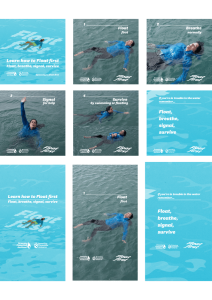
Float first is for everyone – no matter your age, body type, gender or swimming ability. Anyone can accidentally fall into the water or get caught in a strong current or rip. Immersion – which is unplanned or unknown entry into the water – is one of the leading causes of drowning fatalities in Auckland and across Aotearoa. If you don’t have the skills, you’re at risk of panicking, suffering from cold water shock and, tragically, drowning. Float first is about knowing how to respond, stay calm, and survive – especially in the critical first two minutes of getting in trouble in the water. Those first two minutes can make the difference between life and death. The message is simple, and the skills can be practised in a safe, controlled environment alongside a responsible adult (including in one of our education programmes). If you find yourself in trouble in water following these four steps can keep you safe until you can swim to shore or be rescued.

Float first

  • Lie back with your ears underwater, chin up
  • Move your hands to help you float
  • It’s okay if your feet sink
  • Ignore your instinct to swim

Breathe normally

  • Relax
  • Slow your breathing to help you calm down
  • Breathing will get easier

Signal for help

  • Raise your arm
  • Shout for help

Survive by swimming or floating

  • Swim to safety if you can
  • Float when it’s not safe to swim
  • Hold onto anything that helps you float
  • Keep clothes on to stay warmer

Did you know most adults can’t float for as long as they think they can?

Float first is not just for kids. In fact, our study (Stanley, 2021) found most adults think they can float, and two-thirds think they can float for more than five minutes. When we tested floating ability in the water, it was revealed that only 2% could float for more than five minutes, with one-third floating for less than 15 seconds. Everyone can benefit from learning and practising the Float first skills before they get in trouble – so it becomes second nature.

But the good news is: everyone can float.

Whatever your age or experience with water, learning and thinking about floating as a first response is something we should all learn. The good news is everyone has the ability to float – either on their own or with gentle sculling (a figure-eight motion made with your hands in the water which can be accompanied by a gentle flutter kick).

Floating is a vital component of DPA’s educational programmes and is one of the 15 water competencies needed for drowning prevention.

What’s the real-world impact of learning these skills?

Knowing how to Float first saved nine-year-old Joseph’s life. When caught in a rip, instead of trying to swim against it, Joseph stayed calm and floated, until he could be safely rescued. Joseph attended DPA’s Splash holiday programme twice, where he practised water safety skills, behaviours and attitudes like floating, snorkelling, wearing a lifejacket, and more.

You can read more of Joseph’s story here.

Floating saves lives. You can too.

DPA provides education, research and advocacy to prevent drowning. For this Float first campaign we’re calling on you to help us fundraise. Imagine knowing the money you raise or donate will go directly towards water safety education so everyone knows how to enjoy the water safely. Keep reading to find out how you can make a lifesaving difference by being part of our Float first Fundraiser.

I’d love to get behind this campaign. What can I do?

We want to make this fundraiser as fun and simple as possible. That’s why we encourage you to choose from two options. If you’re feeling creative and adventurous, you can design and run your own Float first Fundraiser. Or you can simply donate through our campaign – no matter your fundraising experience or available time, there’s an option for you.

1. Get creative: Create your own Float first Fundraiser

Ask your friends, whānau and colleagues to sponsor you to help us raise money to prevent drowning here in Aotearoa New Zealand. Click the button below to visit our campaign page and select ‘I want to fundraise for this’. Keep reading for fundraising ideas.

2. Don’t have time to organise your own fundraiser? It’s easy to donate now

Want to support our mission to prevent drowning through education but don’t have time to organise your own Float first Fundraiser? Complete this form to donate today.

Design and run your own fundraising campaign.

Ideally your Float first Fundraiser will contain and reinforce the Float first survival response (float, breathe, signal, survive). Here’s 5 ideas for inspiration to get those ideas flowing.

1. Go the distance: move to fundraise.

Kayak, swim, run, bike, walk (or something else – maybe burpees or squats if you’re super keen!). Set yourself a distance and a time period to achieve this challenge – days or weeks, you’re free to choose. Maybe you could aim to finish your challenge on World Drowning Prevention Day on Friday 25 July. Create a fundraising page by clicking the button below and request sponsorship from your friends, whānau and community.

2. Gather together, learn together.

Bring your friends, whānau, or colleagues together for a shared morning tea, potluck dinner, or other social activity. Watch the ‘How to Float firstvideo, get creative with our Float first colouring sheets or do one of the Float first activities on our website. Each participant can donate to your fundraising page and ask their network to support.

3. Friends who float together, stay together: group float.

If you have access to a sheltered body of water (this is really important: it must be done in a safe and controlled environment) – and responsible adults to run the event – get a crew together and float for a set amount of time. Each group member can seek sponsorship for being part of your group’s Float first Fundraiser.

4. Get creative on socials.

What could you do to get online attention for your fundraising campaign? How many different floating positions can you demonstrate (safely in water, against a fun backdrop, or just on the floor!) on social media, can you make your own ‘How to Float first’ video that you think would appeal to your social group? Maybe you could create a song, a rap or poem? Why not run a Float first colouring competition for your followers. Encourage people to learn how to Float first and donate to help prevent drowning in Aotearoa New Zealand.

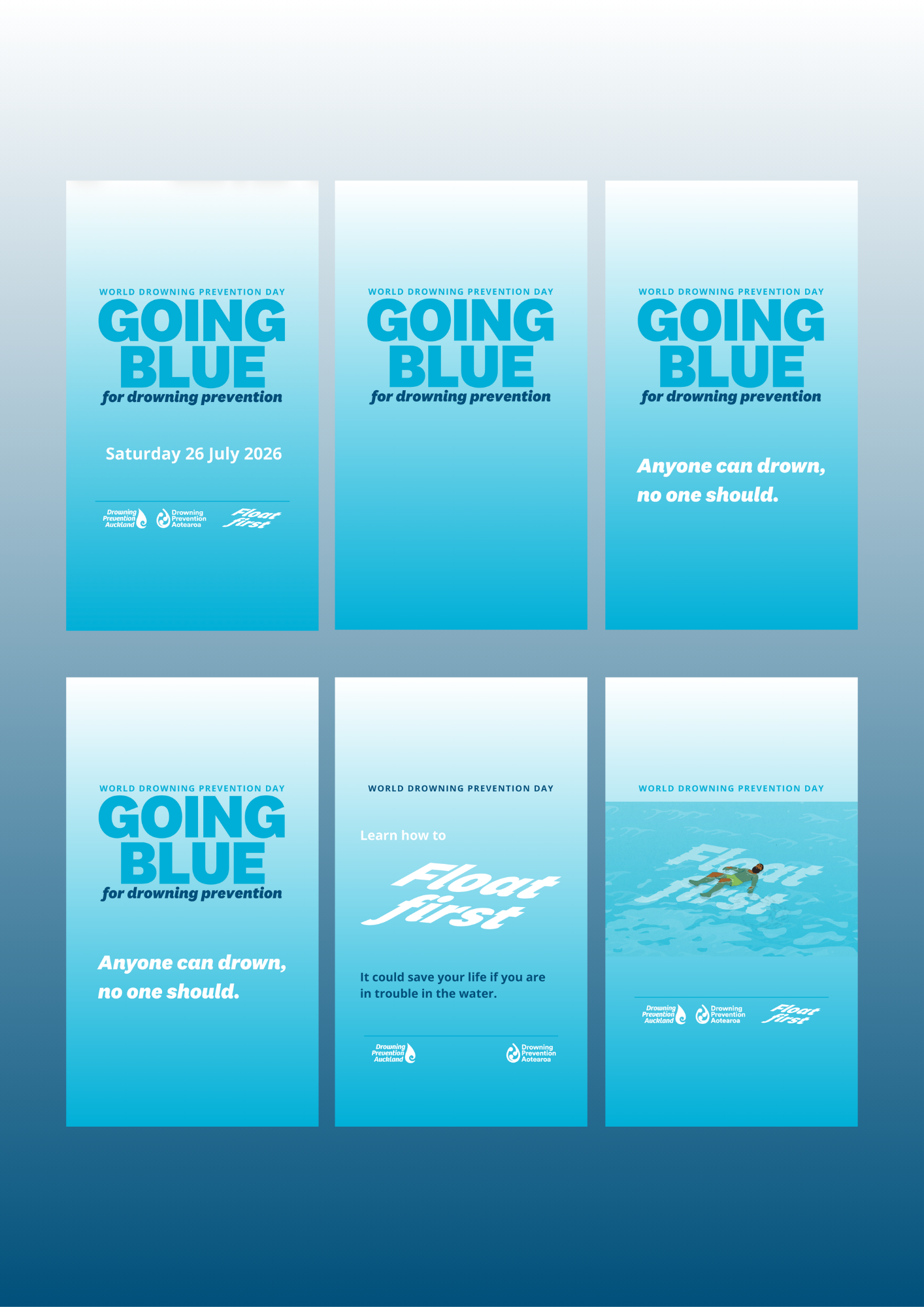
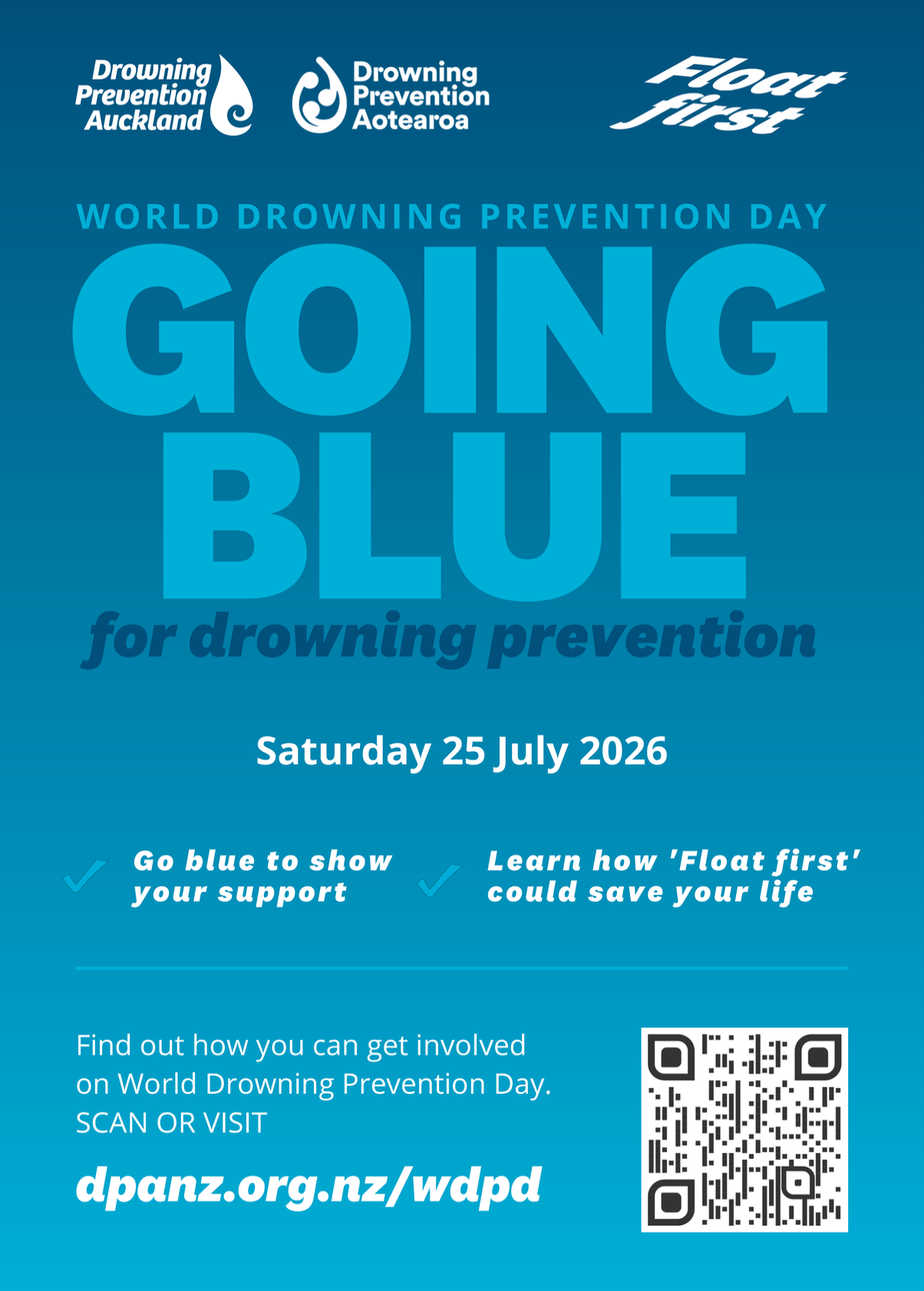
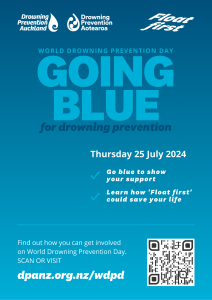
5) Going Blue for World Drowning Prevention Day on 25 July.

Make a day of it, join us in Going Blue for drowning prevention on World Drowning Prevention Day – 25 July. Get your school, workplace or community group to dress in blue for the day, bring blue baking to share, participate in Float first activities (activity worksheet, colouring page – found on our website). Set up your own fundraising page for your community to join in and support.

Why support DPA?

We know your time and money is precious – if this is the first time you’ve come across Drowning Prevention Auckland/Drowning Prevention Aotearoa here’s more about who we are and why our lifesaving work matters. Now in our 31st year, DPA is a charity with a vision of a future free from drowning. This is achieved through developing water competency and changing knowledge, attitudes and behaviours. Aotearoa New Zealand has so many beautiful water environments. In Tāmaki Makaurau Auckland alone, we have the Waitematā, Manukau, and Kaipara harbours; 411km of rivers; 128km of lake edge; and 3700km of coastlines. While wai is the source of life, we need to learn how to respect and understand it to prevent drowning. Our education, research, and advocacy are vital for the wellbeing and safety in, on and around water environments for all people across the country. We help individuals, families, communities and workplaces learn how to be safe from drowning across three channels – where we live, where we work, and where we learn. We’re always grateful for the generous financial support of our donors, partners and sponsors – thank you. You make it possible for us to reach thousands of people up and down the country with our lifesaving research, education and advocacy.

Remember to tag us on socials and use our hashtags

@dpanzDrowningPrevention #FloatfirstFundraiser #FloatingSavesLivesSoCanYou Thanks so much for getting behind our Float first Fundraising campaign. Tag us on your socials or email us photos and description of your fundraising adventures – we can’t wait to see your creativity!

Other news

We All Play a Part this Water Safety Month

We All Play a Part this Water Safety Month

We All Play a Part This Water Safety Month November is New Zealand’s Water Safety Month, and this year’s theme is “We All Play a Part”. Water Safety New Zealand will shine a spotlight on the contributions of individuals, whānau, and communities in drowning prevention...

Be Water Safe

Be Water Safe

A short education session designed to give participants the essential water competence knowledge and understanding they need to feel more confident and safely enjoy everyday situations at the beach, pool, or near water in your community. Key points covered in the...

DPA Aquatic WOF – Building competence and confidence

DPA Aquatic WOF – Building competence and confidence

Learning to stay safe in and around water is important for everyone, regardless of age or ability. The Aquatic Warrant of Fitness (Aquatic WOF) Check from Drowning Prevention Auckland is a free, one-hour session that helps people understand their current water skills...

DPA reaches thousands this summer with research-backed drowning prevention education and advocacy

DPA reaches thousands this summer with research-backed drowning prevention education and advocacy

Drowning Prevention Auckland/Aotearoa (DPA) had another action-packed summer. Our visibility at events and our research-backed initiatives – thanks in large part to the support of our partners and funders – allowed us to continue to reach people in Tāmaki Makaurau Auckland and beyond with our important messages.

From rock and crab fishers to international students, and connecting with the community at nature days, boating and cultural events, DPA continues to educate and advocate for water safety awareness, attitudes, skills and confidence – so everyone can enjoy our country’s beautiful waterways and return home safely.

Please read on for a summery summary of what we’ve been up to.

We had a busy event calendar

Be Water Safe and Portage Crossing events

On Saturday 15 March, DPA participated in the Be Water Safe event and the 33rd Annual Portage Crossing Regatta – an event which consists of three legs: an 18km paddle, a 5km hīkoi through Portage Road, Ōtāhuhu and a final 5km paddle, plus a free family festival to celebrate. In the morning, before the regatta, DPA connected with the local boating community at Māngere Bridge boat ramp to promote responsible boating practices. We raised water safety awareness and encouraged lifejacket use, letting boaties know they can hire lifejackets from one of our 12 DPA Lifejacket Hubs in Auckland (15 across Aotearoa).

Both events were incredible, especially witnessing over 100 paddlers on their waka navigating the same ancient Māori track as the Tainui waka.

Splashy Bikers Nature Day

Te Whau Pathway Environmental Trust organised the Splashy Bikers Nature Day across two dates in March at Archibald Park, Kelston. The event saw a great turnout, with more than 150 students from local schools – including Kelston Girls’ College, Blockhouse Bay Intermediate, Kelston Intermediate and Glenavon School. Students rotated through various nature-based activities including kayaking, outdoor murals, sea cleaning and science experiments. DPA shared essential water safety messages, emphasising the ‘Float first’ survival technique, lifejacket safety protocols, and bystander rescue methods.

Reaching the rescuers: Have a Throw Day

The Drowning Prevention Auckland Have a Throw event – at Karanga Plaza Harbour Pool on 9 March – was a resounding success thanks to a fantastic turnout. An interactive and fun day, the public could have a go at throwing different types of rescue equipment commonly found in Aotearoa New Zealand. Our team shared valuable tips and tricks on how to use public rescue equipment (PRE) safely and effectively in emergency situations. Participants also received important information on boating safety and the Water Safety Code. What a great opportunity to connect with the community, raise awareness, and strengthen water safety education. Thanks to everyone who joined us, and we look forward to more opportunities to work together for a safer, water-aware community.

Thanks also for the support from Your Waterfront and Eke Panuku to make this event happen. You can read more about their latest news here.

New Zealand Chinese Youth Trust Cooking and Baking Competition

DPA had the pleasure of attending this competition for teenagers on 23 February at Takapuna Beach. The event highlighted the importance of getting teenagers and families involved in culinary creativity with a cupcake decoration competition and a sweet/savoury creation competition. There were a few performances and several stalls such as face painting, crochet sales, and food stalls.

DPA had the opportunity to promote our ‘Float first’ campaign, DPA Lifejacket Hubs, and enjoyed a general chat about water safety with the public.

Bucklands Beach Yacht Club Public Open Day

A highlight in the East Auckland social calendar, DPA attended Bucklands Beach Yacht Club Public Open Day on 23 February. The public enjoyed free sailing and kayaking experiences, a magic show, lolly scramble, exhibitors and a children’s fishing competition. DPA promoted our ‘Float first’ campaign, our Lifejacket Hubs, and chatted to the public about water safety.

We reached communities who are at high-risk of drowning

Rock-based fishing: West Coast Experience

On 8 February, DPA teamed up with Surf Life Saving New Zealand for a “West Coast Experience” at Muriwai Beach. With thanks to funding from Water Safety New Zealand, 16 members of the Sparkling Minds Education – an Asian group – learnt how to fish safely from the rocks, bystander rescue techniques, and proper lifejacket use. Participants practised ‘Float first’ methods, HELP (Heat Escape Lessening Posture) and “huddling with others” techniques, and got up to speed on fishing regulations. Many also heard about DPA’s Lifejacket Hubs for the first time.

Water Safety New Zealand Interventions Advisor, Esther Hone-Moore said this comprehensive training is relevant and deeply impactful because it “enhances understanding of real-world hazards such as strong currents, unpredictable weather, and land-based fishing risks. [It] also covers critical survival skills, including what to do when in trouble, recognising the signs of drowning, and safely assisting someone in difficulty.”

Crab fishing

DPA continued its long-standing initiative to educate Asian communities on water safety through the Crab Fishing Programme held at Uretiti Beach, Waipu on 23 February. This initiative began in 2016 and is a collaborative effort between us, police, Ministry for Primary Industries (MPI), and the local Surf Life Saving club.

At Uretiti Beach, we boosted and reinforced the water safety knowledge of 34 participants – knowledge they had gained from a theory session three days earlier.

The programme covered crucial topics, including:

  • identifying local water hazards
  • flotation techniques with and without lifejackets
  • proper selection and use of fitted lifejackets
  • Availability of lifejackets from our Lifejacket Hubs
  • bystander rescue techniques
  • the Water Safety Code
  • crab fishing techniques.

The feedback from participants was overwhelmingly positive.

“I am very grateful for this rare opportunity to learn water safety before any tragedy happens. I learned how to identify rip currents, I appreciate the lifejacket loan scheme, the bystander rescue practice was amazing, and I learned valuable crabbing and tuatua gathering techniques.”

“Checking weather, tide, alongside lifeguard patrolling is so important for me when
I plan any water activities for my family. The crab fishing workshop later echoed what I
learned from the theory session… the feeling of respecting water.”

We continued our flagship programme Wai Wise.

Wai Wise

Between November 2024 and February 2025, DPA’s Wai Wise programme reached nearly 150 participants from high-risk Asian and Pacific communities. Supported by Maritime NZ, the programme combined classroom learning with pool training, and then an open water experience at Vector Wero Whitewater Park.

This programme focuses on improving water safety culture within high-risk ethnic communities. Nearly 150 participants gained practical knowledge and skills through theory and pool training, culminating in an open water training experience at Vector Wero Whitewater Park. The course promoted “Float first” principles as a core water competency in drowning prevention, as well as the Boating Safety Code, particularly on always wearing lifejackets.

MP Nancy Lu – who had the opportunity to participate in Wai Wise – said:

“In my Asian communities, there is a clear demand for this kind of education, especially for those who are new to New Zealand. This programme is essential for fostering a culture of water safety. I am thankful to have been a part of it.”

We shared our water safety messages with international students.

University of Auckland

DPA shared essential water safety messages with over 900 international students – a great way to kick off their semester at the University of Auckland – Waipapa Taumata Rau.

DPA is grateful to the university and supports the water safety emphasis for international students. Juliane Adamietz from International Student Support Services said:

“I am truly happy that this session is a standing part of our International Orientation at the University of Auckland.”

The beauty of Aotearoa, including our many beaches and other waterways, is a drawcard for many of the students who will be out enjoying the wai very soon! This programme is a great intro to their water safety journey – with many students showing a keen interest in the DPA lifejacket hubs and learning how to ‘Float first’.

Under Drowning Prevention Aotearoa, we reached people in the Bay of Plenty.

Developing Water Safety – a one-day course delivered in Tauranga and Ōpōtiki

This summer, thanks to support from Maritime NZ, Drowning Prevention Aotearoa delivered two one-day water competence courses in Tauranga and Ōpōtiki, significantly boosting participants’ water safety skills and awareness. Grounded in international best practice research, the course focuses on the 15 key water competencies, lifejacket safety, and boating safety. Importantly, it also includes Coastguard’s Safer Boating module to equip attendees with essential skills for safer decision-making on the water.

Through hands-on learning, participants are trained to:

  • identify aquatic hazards in various water environments
  • develop their water competence
  • practise in-water survival skills under supervision
  • use PRE (public rescue equipment) and learn safe bystander rescue techniques
  • retain the 4R rescue method: Recognise, Respond, Rescue, Revive.

Across three course sessions, 14 participants completed the training. The courses, aligned with the Safer Boating Forum’s Recreational Craft Strategy, saw significant improvements in participants’ water safety knowledge and abilities.

The course had a profound impact. Here are some key metrics:

  • 125% increase in floating ability (all attendees could float for over two minutes)
  • 9% improvement in water safety knowledge
  • 48% growth in water safety confidence
  • 100% of participants reported positive changes in their attitude and behaviour towards and around water.

When it comes to attitude change, one attendee said: “The course taught me not to overestimate my floating/swimming ability and not to endanger myself while rescuing others.”

Inspired by the impact we make? You can be a part of it.

This summer, we couldn’t have attended all these events – and delivered our lifesaving drowning prevention work – without the support of our donors, volunteers and water safety advocates.

Whether you choose to donate, volunteer, or spread awareness about water safety, your contribution matters.

Together, we can create a future where every whānau can safely enjoy aquatic experiences.

Make a difference – Donate today

Your support is an investment in safer communities and saved lives. With every donation, we can reach even more communities with our research-backed, international best practice water safety education and advocacy.

If you’re able to contribute, please consider donating today.

Thank you for being part of our mission to prevent drowning in Aotearoa New Zealand.

DPA – Saving lives all year round through research-backed water safety education.

Other news

We All Play a Part this Water Safety Month

We All Play a Part this Water Safety Month

We All Play a Part This Water Safety Month November is New Zealand’s Water Safety Month, and this year’s theme is “We All Play a Part”. Water Safety New Zealand will shine a spotlight on the contributions of individuals, whānau, and communities in drowning prevention...

Be Water Safe

Be Water Safe

A short education session designed to give participants the essential water competence knowledge and understanding they need to feel more confident and safely enjoy everyday situations at the beach, pool, or near water in your community. Key points covered in the...

DPA Aquatic WOF – Building competence and confidence

DPA Aquatic WOF – Building competence and confidence

Learning to stay safe in and around water is important for everyone, regardless of age or ability. The Aquatic Warrant of Fitness (Aquatic WOF) Check from Drowning Prevention Auckland is a free, one-hour session that helps people understand their current water skills...

Supporting DPA: How Your Contribution Saves Lives

Supporting DPA: How Your Contribution Saves Lives

Every year, preventable drownings impact families and communities across Aotearoa New Zealand. At Drowning Prevention Auckland/Aotearoa (DPA), our mission is clear: to reduce these tragic incidents through education, advocacy, and research-driven initiatives. As a registered charity, we rely on the support of generous donors to continue this vital work.

Education: Changing behaviours, developing understanding and ability, saving lives.

Education is at the heart of drowning prevention. Our programmes equip individuals, families, and communities with essential water competence, from understanding their own abilities and developing their knowledge, attitudes and behaviours around water to using lifejackets and knowing how to safely rescue someone in trouble in the water. With your support, we can reach more schools, community groups, and at-risk populations, ensuring everyone has the knowledge they need to stay safe in and around water.

Research: Evidence-based solutions

Every initiative we undertake is guided by robust peer-reviewed research. From analysing drowning statistics to studying high-risk behaviours, research ensures our programmes are targeted and effective. Your contributions directly support ongoing studies that inform and improve our approach to water safety.

Advocacy: Raising awareness, driving change

Sharing water safety messages is key to changing behaviour and keeping communities safe. At Drowning Prevention Aotearoa (DPA), we work hard to make these messages heard—teaching people about safer practices in, on and around water.

Your donation helps us amplify these messages, reaching more people, therefore driving meaningful change to prevent drownings across Aotearoa New Zealand.

The impact of your support

Every dollar donated to DPA makes a difference. Your support helps us:

  • Deliver life-saving education programmes
  • Provide training and share water safety messages to at-risk communities
  • Conduct research to prevent future incidents

A Shared Responsibility

Preventing drowning is a collective effort. Whether you choose to donate, volunteer, or spread awareness about water safety, your contribution matters. Together, we can create a future where every whānau can safely enjoy aquatic experiences.

Make a Difference – Donate today

Your support is more than just a donation—it’s an investment in safer communities and saved lives. If you’re able to contribute, please consider donating today.

Thank you for being part of our mission to prevent drowning in Aotearoa New Zealand.

DPA – Saving lives through research-backed water safety education.

Other news

We All Play a Part this Water Safety Month

We All Play a Part this Water Safety Month

We All Play a Part This Water Safety Month November is New Zealand’s Water Safety Month, and this year’s theme is “We All Play a Part”. Water Safety New Zealand will shine a spotlight on the contributions of individuals, whānau, and communities in drowning prevention...

Be Water Safe

Be Water Safe

A short education session designed to give participants the essential water competence knowledge and understanding they need to feel more confident and safely enjoy everyday situations at the beach, pool, or near water in your community. Key points covered in the...

DPA Aquatic WOF – Building competence and confidence

DPA Aquatic WOF – Building competence and confidence

Learning to stay safe in and around water is important for everyone, regardless of age or ability. The Aquatic Warrant of Fitness (Aquatic WOF) Check from Drowning Prevention Auckland is a free, one-hour session that helps people understand their current water skills...

AGM and Spring Research Forum

AGM and Spring Research Forum

Notice of Annual General Meeting of WaterSafe Auckland Inc trading as Drowning Prevention Auckland.

WaterSafe Auckland’s 30th AGM will be held at Drowning Prevention Auckland, 85 Westhaven Drive, Westhaven, Auckland on Wednesday 27 November 2024 at 4.00pm. Please direct any enquiries to brooke.paul@dpanz.org.nz.

Vacancies on the Board exist as per clause 13.7 of the WaterSafe Auckland constitution. Please indicate if you would like a nomination form. Completed nomination forms from WaterSafe Auckland members must be received no later than 10 days before the AGM. Please email completed nomination form, addressed to The Secretary, along with a CV to nicola@dpanz.org.nz by Monday 18 November 2024 at 5.00pm.

Please RSVP by Wednesday 21 November 2024 to brooke.paul@dpanz.org.nz. Meeting material will be circulated by email to those that can attend.

Spring Research Forum

Prior to the AGM at the same venue, we will hold the Spring Research Forum. Starting at 2pm, the forum will cover a range of topics. See the full list of presenters and their topics below.

  • RUKU Tauihi: Safer Kaimoana Gathering to Prevent Drowning – Ants Lowe
  • Float first – Tamsin O’Sullivan
  • Hazards Assessments for Land Managers – Josh Carmine
  • Public Rescue Equipment Guidelines – Dr Mick Kearney
  • Safety Information Provided at Point of Sale – Josh Carmine
  • Surfers Rescue – Dr Loic Le De, AUT

The presentations will be followed by a Forum Q&A facilitated by Dr Kevin Moran.

Other news

We All Play a Part this Water Safety Month

We All Play a Part this Water Safety Month

We All Play a Part This Water Safety Month November is New Zealand’s Water Safety Month, and this year’s theme is “We All Play a Part”. Water Safety New Zealand will shine a spotlight on the contributions of individuals, whānau, and communities in drowning prevention...

Be Water Safe

Be Water Safe

A short education session designed to give participants the essential water competence knowledge and understanding they need to feel more confident and safely enjoy everyday situations at the beach, pool, or near water in your community. Key points covered in the...

DPA Aquatic WOF – Building competence and confidence

DPA Aquatic WOF – Building competence and confidence

Learning to stay safe in and around water is important for everyone, regardless of age or ability. The Aquatic Warrant of Fitness (Aquatic WOF) Check from Drowning Prevention Auckland is a free, one-hour session that helps people understand their current water skills...